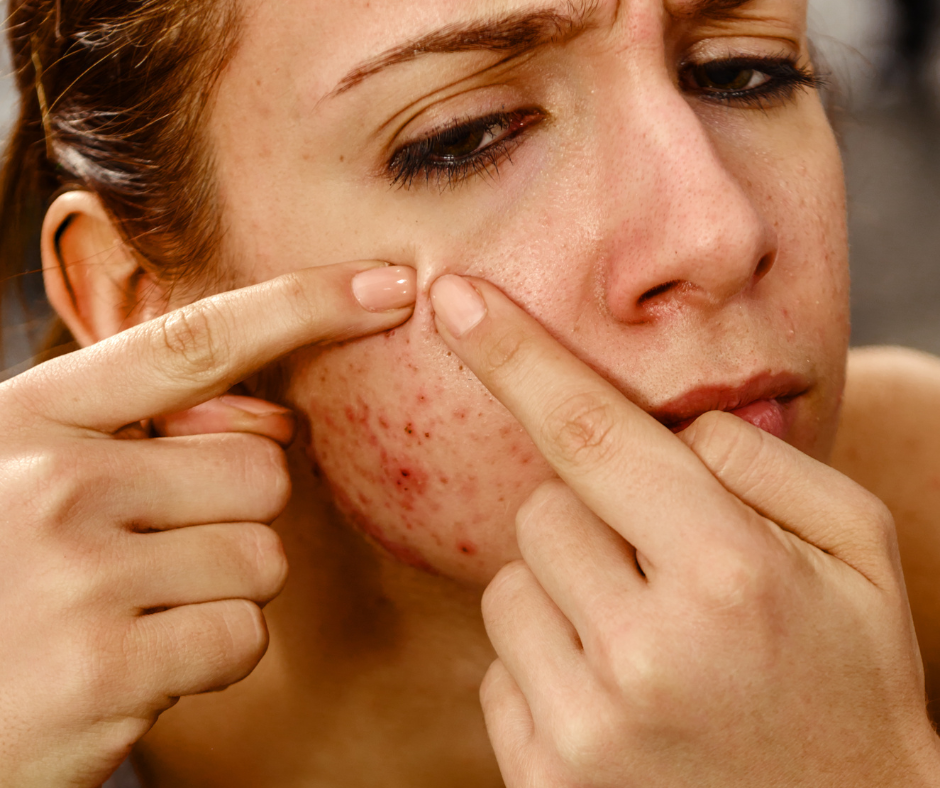
You made it through your teenage years with relatively clear skin. Now, in your late twenties, you’re getting deep, painful, cystic breakouts along your jawline that no cleanser, toner, or topical treatment is clearing. You are not imagining it. And your skincare routine is not the problem.
Adult-onset cystic jawline acne is one of the most common presentations we see in functional medicine practice — and one of the most frustrating for the women who experience it. It tends to appear in the late twenties or early thirties, clusters predictably along the jawline and chin, worsens in the week before a period, and responds poorly to the conventional treatments recommended for teenage acne. That’s because it is not teenage acne. It is a hormonal and inflammatory condition that needs to be addressed from the inside, not the outside.
This article explains exactly what causes cystic jawline acne in adult women, what the location of your breakouts tells you about your hormonal terrain, and what a functional medicine approach looks like when it comes to treating the root cause rather than managing the surface.
Why the jawline specifically
Acne face mapping is not pseudoscience. There is genuine anatomical logic to where breakouts appear on the face, and the jawline and chin area is one of the most hormonally specific locations in the body. The sebaceous (oil) glands along the jaw and lower face have a disproportionately high concentration of androgen receptors compared to other areas of the face. Androgens — hormones like testosterone and dihydrotestosterone (DHT) — directly stimulate sebaceous gland activity: increasing oil (sebum) production, accelerating skin cell turnover, and creating the conditions for pore blockage and bacterial overgrowth that result in acne.
When cystic acne appears specifically along the jawline, lower cheeks, and chin — particularly when it is cyclical, worsening before a period and improving once menstruation begins — the hormonal diagnosis is almost certain. The question is not whether hormones are involved. The question is which hormonal mechanism is driving the androgen excess at the skin level.
Jawline acne in adult women is almost never a skincare problem. The sebaceous glands along the jaw are exquisitely sensitive to androgens — and when those glands are overactive, the driver is almost always hormonal, inflammatory, or both.
The root causes of hormonal jawline acne
Androgen excess: the direct mechanism
Androgens — primarily testosterone and its more potent derivative DHT (dihydrotestosterone) — bind to androgen receptors in sebaceous glands and trigger two acne-promoting effects simultaneously: they increase sebum production and accelerate keratinocyte (skin cell) proliferation. More oil plus faster skin cell turnover means more clogged pores, more anaerobic bacterial overgrowth (Cutibacterium acnes), and deeper, more inflammatory cystic lesions.
In adult women, androgen excess can arise from several sources. Polycystic ovarian syndrome (PCOS) is the most well-known, involving elevated ovarian androgen production driven by insulin resistance and LH excess. But androgen-driven jawline acne also occurs in women without PCOS — in those with elevated adrenal androgens (DHEA-S), in those with increased 5-alpha reductase activity converting testosterone to the more potent DHT, and in those with increased peripheral androgen sensitivity even when circulating levels appear normal on standard bloodwork.
This last point is critical: a woman can have jawline acne driven by androgens even when her total testosterone measures within range — because it is the sensitivity of the androgen receptors and the local conversion of testosterone to DHT at the skin level that determines the skin response, not just the blood level.
Oestrogen dominance and progesterone insufficiency
Progesterone has a direct anti-androgenic effect. It competitively inhibits 5-alpha reductase — the enzyme that converts testosterone to the more potent DHT — and it competes with androgens at the receptor level in skin tissue. When progesterone is low relative to oestrogen, this protective anti-androgenic effect is lost, and the skin becomes more sensitive to whatever androgens are circulating.
This is why jawline acne so frequently worsens in the luteal phase — the week before a period — when progesterone is dropping. It is also why women coming off the contraceptive pill frequently develop significant jawline breakouts: the synthetic progestins in the pill had been providing this anti-androgenic effect, and when they are removed, the skin is suddenly exposed to the full androgenic environment without protection.
Insulin resistance and the IGF-1 connection
Insulin is one of the most powerful drivers of androgen production in women. Elevated insulin directly stimulates the ovaries to produce more testosterone, reduces sex hormone binding globulin (SHBG — the protein that binds and inactivates testosterone), and increases IGF-1 (insulin-like growth factor 1). IGF-1 stimulates sebaceous gland activity and keratinocyte proliferation by exactly the same mechanism as androgens — making insulin resistance one of the most significant and most overlooked dietary drivers of hormonal acne.
The typical South African diet — high in refined carbohydrates, white bread, sugary drinks, processed foods, and frequent snacking — creates a chronically elevated insulin environment that promotes androgen-driven acne independently of any other hormonal imbalance. Women who notice their breakouts worsen after periods of higher sugar or carbohydrate intake are observing this mechanism directly.
Diet is not the whole story with hormonal acne — but blood sugar dysregulation is a direct and measurable driver of androgen production at the ovarian level. Stabilising insulin is one of the most impactful dietary interventions for jawline acne, and it works within weeks.
Gut health and oestrogen recirculation
Gut dysbiosis and elevated beta-glucuronidase activity recirculate oestrogen that should have been excreted — contributing to the oestrogen dominance that removes progesterone’s anti-androgenic protection. But the gut-acne connection goes further than oestrogen metabolism. Gut dysbiosis drives systemic inflammation through LPS (lipopolysaccharide) translocation into circulation, which directly promotes inflammatory acne lesion formation and worsens skin barrier function. Women with gut symptoms — bloating, irregular bowel movements, food sensitivities — alongside jawline acne should always have their gut health investigated as part of any comprehensive hormonal acne workup.
Post-pill acne: why it appears and what to do
Post-pill acne is one of the most common presentations we see in women in their mid-to-late twenties, and it is almost entirely concentrated on the jawline and lower face. The mechanism is a rebound surge in androgens after the pill is stopped. The combined oral contraceptive pill suppresses ovarian androgen production and increases SHBG, reducing free testosterone significantly. When the pill is discontinued, ovarian androgen production rebounds — often to levels higher than pre-pill baseline — while SHBG remains suppressed for months. The result is a spike in free androgens that hits the jawline’s sebaceous glands hard.
Post-pill acne typically peaks three to six months after stopping the pill and can persist for up to twelve months or longer if the underlying hormonal terrain is not addressed. It is not a reason to go back on the pill — it is a reason to investigate and correct the hormonal imbalance that the pill was masking.
A functional medicine approach to hormonal jawline acne
Treating cystic jawline acne from a functional medicine perspective means addressing the hormonal, metabolic, and inflammatory drivers simultaneously — not prescribing a topical antibiotic and hoping for the best. A thorough investigation includes a full hormone panel (testosterone, free testosterone, DHEA-S, SHBG, oestradiol, progesterone timed to day 21, LH, FSH), fasting insulin and glucose, inflammatory markers, and gut health assessment where indicated.
The protocol that follows is layered and targeted. Blood sugar stabilisation through dietary change is the first and fastest-acting lever. Liver support to improve oestrogen clearance and reduce oestrogen dominance follows. Gut restoration to lower beta-glucuronidase activity and systemic inflammation is a medium-term intervention. Zinc — one of the most evidence-based nutritional interventions for acne — inhibits 5-alpha reductase, reduces sebum production, and has direct anti-inflammatory effects at the skin level. Zinc Glycinate by Metagenics provides highly absorbable zinc in the form most bioavailable for skin and hormonal support.
Liver oestrogen detoxification is supported by DIM (diindolylmethane) and calcium d-glucarate — both available in formulations designed specifically for hormonal balance. EstroFactors combines DIM with calcium d-glucarate and other co-factors to support healthy oestrogen metabolism through both Phase 1 and Phase 2 liver detoxification pathways — directly addressing the oestrogen dominance that removes progesterone’s anti-androgenic skin protection. For gut microbiome restoration, UltraFlora Balance provides targeted probiotic support to restore healthy estrobolome function and reduce systemic inflammatory load.
Targeted support for hormonal jawline acne
The bottom line
Cystic jawline acne at 27 is not bad luck, not a hygiene problem, and not a teenage phase you have somehow carried into adulthood. It is a skin manifestation of a hormonal and inflammatory imbalance that is happening systemically — and it will not resolve with topical treatments alone. Addressing the root cause requires understanding your specific hormonal pattern: which androgens are elevated or overactive, whether oestrogen dominance is removing progesterone’s protective effect, whether insulin resistance is driving ovarian androgen production, and whether gut or liver function is contributing to the hormonal load your skin is responding to.
The first step is getting clarity on your hormonal terrain. Take the free hormone assessment quiz at Hormone Reset to identify the imbalance pattern most likely driving your skin symptoms — and to start treating the cause rather than the surface.
Your skin is a mirror of what is happening inside your body. Cystic jawline acne is one of its most direct hormonal messages — and when you address what is driving it internally, the skin clears in a way that no topical treatment can achieve alone.
Ready to identify the hormonal root cause of your jawline acne and treat it from the inside out?
Take the free hormone assessment quiz